




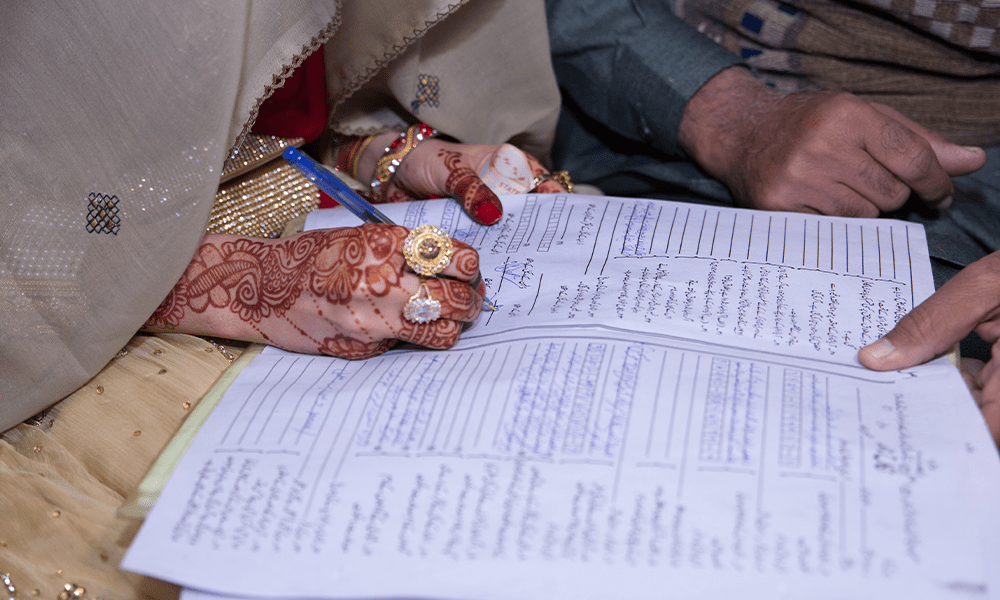
This article is written by Jiya Aggarwal of 5th Semester of BA.LLB of Vivekananda Institute of Professional Studies, Delhi, an intern under Legal Vidhiya
ABSTRACT
This article deals with different aspects of Nikah, which is a corresponding term to marriage, such as meaning of nikah, its nature and objectives. Moreover, as nikah is considered as necessary for procreation and for purposes of sexual relations, this article will delve into the essentials of valid Muslim marriage, what are necessary requirements for a valid marriage. Apart from that, it will deal with prohibited relationships with whom the marriage cannot be contracted. These prohibitions can be mandatory and directory which this article will be dealing with. Lastly, it will deal with types of marriages in Muslim law. This article will enhance your knowledge about Muslim marriage by exploring all the aspects of Nikah giving holistic view of Muslim marriage.
KEYWORDS
Muslim law, Valid Muslim marriage, Nature of nikah, Prohibitions under Muslim law, Types, Objective of Nikah, Essentials of Nikah
INTRODUCTION
Marriage is considered as a purest and oldest form of institution. Its objective differs from religion to religion. In pre–Islamic Arabia, marriage did not exist as it exists today. The only object of marriage used to be enjoyment of sex and procreation of children. There was no regulated form of marriage. Women were no less than slaves and had no status in society. When Islam came into existence, due status was given to women and all other forms of marriage were abrogated except for dower. Thus, a prescribed form of marriage was introduced, Nikah in which consent was essential. It is not only a matrimonial contract but also a social institution which gave a dignified status to a woman. Islam basically in religious sense means ‘submission to the Will of god.’ Quran mentions that Islam has been in the existence since the beginning of the world. There are four primary sources of Islamic law- the Quran, the Sunna, the Ijma and the Qiyas. Quran and hadith are primary sources which govern the marriage union. The basic objective with which Islam introduced the concept of Nikah was for perpetuation of human race and attainment of chastity, continence, mutual love, affection, and peace. The institution of marriage sanctioned the sexual relation, fixing the human descent and encouraging mutual help of husband and wife in earning livelihood. It is important to know that Islam does not permit premarital sexual relations and acts outside of marriage. Dating, adultery, secret paramours, and experimental living together are regarded as severe penalties in the Quran.[1]
In this article, we will delve into more detail as to what is Nikah, what is the nature of Muslim marriage, essentials of Muslim marriage and the prohibitions in Muslim marriages. Furthermore, we will discuss what is the object of Muslim marriage and what are the types of Muslim marriages.
DEFINITION OF NIKAH (MARRIAGE)[2]
In Arabs law Nikah has a wider interpretation while in Muslim law, it has definite legal meaning. Some of the definitions of Muslim marriage are:
According to Hidaya Marriage is a legal process which legitimises union of man and woman and the procreation of children.
According to Bailies Digest, Nikah means ‘union of series’ and is a civil contract which legitimises sexual intercourse and procreation of children.
According to Ameer Ali marriage is an institution which is ordained for protection of society and to guard themselves from foulness and unchastity.
According to Abdul Raheem the institution of marriage as partaking of the nature of ‘Ibadat’ which is devotional acts and ‘Muamlat’ which means dealings among men.
Marriage in Muslim law is not only a civil contract, but also a sacrament. In its legal sense, it is a contract which legitimises the intercourse, the procreation of children and regulates the social life. In Hadith of prophet, institution of marriage has its greatest emphasis as ‘Marriage is my Sunna. Whoever keeps away from it is not from me.’
NATURE OF MUSLIM MARRIAGE (NIKAH)
There is no unanimous opinion on whether the Muslim marriage is purely a civil contract or is a religious acronym in nature.
In the case of Abdul Kadir vs Salima (1886)[3] it was court observed that the nature of Muslim marriage is like a civil contract as there is offer in it and the acceptance of that offer are essential elements of marriage. Also, free consent is what makes it valid.
By many writers and jurists, it is treated as a mere civil contract and not a sacrament. Their observations are based on the following characteristics:
- In marriage there is a proposal (Ijab) and there is acceptance (Qabul) which are essentials of contract. Also, free consent is essential for a valid Muslim marriage. Thus, it is a civil contract.
- In Muslim law, on attaining of age of puberty the marriage can be set aside which is also the case of civil contract.
- Just as in contract, the parties to marriage can enter into pre-nuptial agreement which is enforceable by law.
This observation of Justice Mahmood cannot solely be accepted based on certain similar features between contract and Muslim marriage. There is social as well religious aspect of Nikah. The institution of Nikah gave women a dignified status in the society by establishing a social institution which uplifted the women. On the other hand, Nikah has a religious aspect as Quran directs every Muslim to marry a woman of their liking and it is duty of every Muslim to marry otherwise it will be considered as a sin.
Thus, it can be concluded that the nature of Muslim marriage is that it is a blend of both civil contract as well as sacrament.
ESSENTIALS OF VALID MUSLIM MARRIAGE[4]
Muslim marriage is known for its simplicity. It does have any formalities but there are certain conditions that are essential for a valid Muslim marriage. These are:
- Competency of the Parties– the parties are competent when they-
a) Attain the age of puberty– Puberty is assumed to be at completion of 15 years. Provisions of Indian Majority Act, 1875 does not apply to matters related to marriage, dower, and divorce
b) are of sound mind
c) are Muslim
- Free Consent of the Parties– The parties contracting marriage must give their consent freely without any force, fraud, or compulsion. If the consent is taken by compulsion, it will be void under all schools of Muslim law except for Hanafi law. If the consent is taken by fraud, it is voidable at the option of the defrauded party. If consent given under any mistake of fact, then it is void.
- Proposal and Acceptance– The only two essential formalities under the Muslim law are the offer and the acceptance both of which are expressed at one meeting in presence of two male or one male and two female witnesses. Offer signifies the willingness to contract the marriage and is generally made from the side of the boy. The offer for marriage must be accepted (Qabul) by the girl or her guardian. The offer and acceptance can be oral or in writing but the words must be clear and unambiguous and express a clear intention of the parties to marry.
PROHIBITIONS UNDER MUSLIM MARRIAGE[5]
Under Muslim law a valid marriage will be considered one where there are no prohibitions in the marriage between the persons. There are two kinds of prohibitions in Muslim marriage:
- Absolute Prohibitions
- Relative Prohibitions
ABSOLUTE PROHIBITIONS
These prohibitions are mandatory in nature and marriage contracted in violation of any absolute prohibitions will be considered as null and void under all the schools of Muslim law. Valid marriage is that where the prohibited relationship between the party is absent. The prohibited relationship is when a person is related with other by- Consanguinity, Affinity, or Fosterage.
- Consanguinity – It means relations by blood A Muslim cannot marry with any office following relations: one’s own ascendant or descendant how highsoever, descendants of one’s father and, or mother, how lowsoever brothers or sisters of one’s ascendent, how highsoever.
- Affinity– It means relations by marriage. Based on affinity, one cannot marry any of the following relations: ascendant or descendant of one’s wife or husband; wife or husband of one’s ascendant or descendant.
- Fosterage– It means relation by milk. Where a child, under the age of 2 years has sucked the milk of any woman, such woman called foster mother of that child. Despite not having blood relationship between the woman and the child, she is considered as the real mother of that child.
RELATIVE PROHIBITIONS
These are those prohibitions which are not mandatory in nature but their presence is deemed to be unjust. The marriage contracted in violation of these are merely irregular and not void marriage. Under Sharia law these prohibitions are directory and does not have any legal effect. Under Shia law, there is no irregular marriage, there is either void or valid marriage.
The relative prohibitions are:
- Unlawful Conjunction– A Muslim cannot marry two wives who are related to each other by consanguinity, affinity, or fosterage. Such marriage will be considered as irregular. Under Shia Law, marriage under unlawful conjunction is void except marriage with wife’s aunt.
- Marriage With 5th Wife– Polygamy is allowed up to four wives in Muslim law but he is prohibited to marry the 5th wife. After the death or divorce with one of the four wives, of search irregularity will be cease to exist. Under Shia law it is a void marriage.
- Marriage With a Non-Muslim– Under Sunni law, it is only irregular marriage but under Shia law it is void.
- Marriage Without Witnesses– A marriage without witnesses is merely irregular under Sunni law. Under Shia law, the presence of witnesses is not necessary and such marriage is valid.
- Marriage During Iddat– Iddat is a temporary prohibition period which a divorced or widow woman must undergo, during which she cannot marry. Under Sunni law such marriage is irregular, but under Shia law such marriage is void.
OBJECTIVES OF MUSLIM MARRIAGE[6]
The objectives or the purpose of nikah are prescribed as per holy legislation-Quran and Sunna and the spouses cannot refuse their right and responsibilities.
- The first and foremost basic objective of marriage in Islam is to find comfort between husband and wife. As Holy Quran says: “One of His signs is that He created for you spouses of your own species, so that you might find comfort with them. And He put mutual love and affection in your hearts. Surely in this there are lessons for the thinking people” (30:21) This means nikah aims to establish a sacred bond between husband and wife.
- Another objective mentioned in Quran is procreation of healthy, virtuous, and faithful children. According to Holy Quran says: “He is the Creator of the heavens and the each. He has given you partners from among yourselves and, similarly, made the cattle also males and females. That is how he multiplies you. Nothing can be compared to Him, He is the All-hearing, the All-seeing.” (43:11)[7]
- Third objective is to share equal responsibilities and that both the husband and wife must run household together and keep the family together.
- Fourth objective of nikah is to establish social stability and establish mutual relations of rights and responsibilities between the spouses and the children.
TYPES OF MUSLIM MARRIAGES[8]
There are two types of Muslim marriages:
- Temporary marriage
- Permanent marriage
TEMPORARY MARRIAGE (MUTA MARRIAGE)
Muta marriages are marriage for pleasure and it is a temporary union between male and female for a specified duration on payment of some consideration. The specified may be a day, a month or a year, or a term of years. Muta literally means ‘enjoyment.’
PERMANENT MARRIAGE
- Valid (sahih) Marriage- It is that marriage which is neither void nor irregular This kind of marriage confirms with all the aspects of a valid muscle marriage It covers all the requirements such as proposal, acceptance competency to marriage, consent, etc. The legal effect of such valid marriage is that sexual intercourse becomes lawful, and the children are legitimate. Moreover, the wife becomes entitled to her dower and to maintenance. There are mutual rights of inheritance.
- Void (batil) Marriage- A void marriage is that which are in violation of prohibited relationship such as fosterage, affinity, etc. it does give wife any entitlement to maintenance and she is not entitled to dower. The offspring of such marriage are illegitimate.
- Irregular (Fasid) Marriage- It is that marriage where an illegality exits and which if removed will make the marriage valid. Marriage contracted in violation of any directory prohibition may be referred to as irregular marriage. The legal effect of such marriage will be that cohabitation is lawful, children will be lawful but wife will not be entitled to dower and have no mutual rights of inheritance.
CONCLUSION
Thus, the concept of marriage in Islam is not only a mere contract but it goes beyond that to create mutual love, affection, and spiritual bond. The main objective of it is to make family that has true companionship, is faithful and stand with each other through thick and thin. Through this article we also realised that there is certain absolute prohibited relationship which Muslims cannot marry and there are certain directory prohibitions which will not render a marriage void but only irregular. Understanding the various aspects of nikah helps one to expand their knowledge about Muslim marriage and gives the holistic view of the nature of the marriage in Islam.
REFERENCES
- India, legal S. (no date) Concept of marriage in Muslim law, Legal Service India. Available at: https://www.legalserviceindia.com/article/l162-Concept-of-Marriage-in-Muslim-Law.html (Accessed: 07 September 2024).
- Abdul Kadir v. Salima, 1886 SCC Online All 3,
- Drishti Judiciary Marriage (Nikah) in Muslim law, Drishti Judiciary. Available at: https://www.drishtijudiciary.com/to-the-point/ttp-muslim-law/marriage-nikah#:~:text=Definition%20of%20Marriage%20(Nikah)%20%2D,%2C%20and%20procreation%20of%20children%22. (Accessed: 08 September 2024).
- Prohibited relationships in Muslim law (2022) Nyaaya. Available at: https://nyaaya.org/legal-explainer/what-are-prohibited-relationships-under-the-law/ (Accessed: 08 September 2024).
- Naseem, Razi. (2013). Importance and Objectives of Marriage in Islam: An Analysis of Pakistani Nikah Namah in the Light of the Provisions of the Qur᾿ᾱn and the Sunnah. 2. 113-124.
- Thequranblog (2010) Fiqh Oif Nikah (marriage), The Quran Blog – Enlighten Yourself. Available at: https://thequranblog.wordpress.com/2010/06/23/fiqh-oif-nikah-marriage/ (Accessed: 07 September 2024).
- Different types of Marriage in Islam, https://www.ucis.pitt.edu/global/sites/default/files/curriculum_materials/contributed/DifferentTypesofMarriageinIslam.pdf
[1] Chapter 3: The Islamic Marriage System Islam Ahmadiyya. Available at: https://www.alislam.org/book/pathway-to-paradise/islamic-marriage-system/ (Accessed: 07 September 2024).
[2] India, legal S. Concept of marriage in Muslim law, Legal Service India. Available at: https://www.legalserviceindia.com/article/l162-Concept-of-Marriage-in-Muslim-Law.html (Accessed: 07 September 2024).
[3] Abdul Kadir v. Salima, 1886 SCC Online All 3,
[4] Drishti Judiciary Marriage (Nikah) in Muslim law, Drishti Judiciary. Available at: https://www.drishtijudiciary.com/to-the-point/ttp-muslim-law/marriage-nikah#:~:text=Definition%20of%20Marriage%20(Nikah)%20%2D,%2C%20and%20procreation%20of%20children%22. (Accessed: 08 September 2024).
[5] Prohibited relationships in Muslim law (2022) Nyaaya. Available at: https://nyaaya.org/legal-explainer/what-are-prohibited-relationships-under-the-law/ (Accessed: 08 September 2024).
[6] Naseem, Razi. (2013). Importance and Objectives of Marriage in Islam: An Analysis of Pakistani Nikah Namah in the Light of the Provisions of the Qur᾿ᾱn and the Sunnah. 2. 113-124.
[7] Thequranblog (2010) Fiqh Oif Nikah (marriage), The Quran Blog – Enlighten Yourself. Available at: https://thequranblog.wordpress.com/2010/06/23/fiqh-oif-nikah-marriage/ (Accessed: 07 September 2024).
[8] Different types of Marriage in Islam, https://www.ucis.pitt.edu/global/sites/default/files/curriculum_materials/contributed/DifferentTypesofMarriageinIslam.pdf
Disclaimer: The materials provided herein are intended solely for informational purposes. Accessing or using the site or the materials does not establish an attorney-client relationship. The information presented on this site is not to be construed as legal or professional advice, and it should not be relied upon for such purposes or used as a substitute for advice from a licensed attorney in your state. Additionally, the viewpoint presented by the author is personal.

