


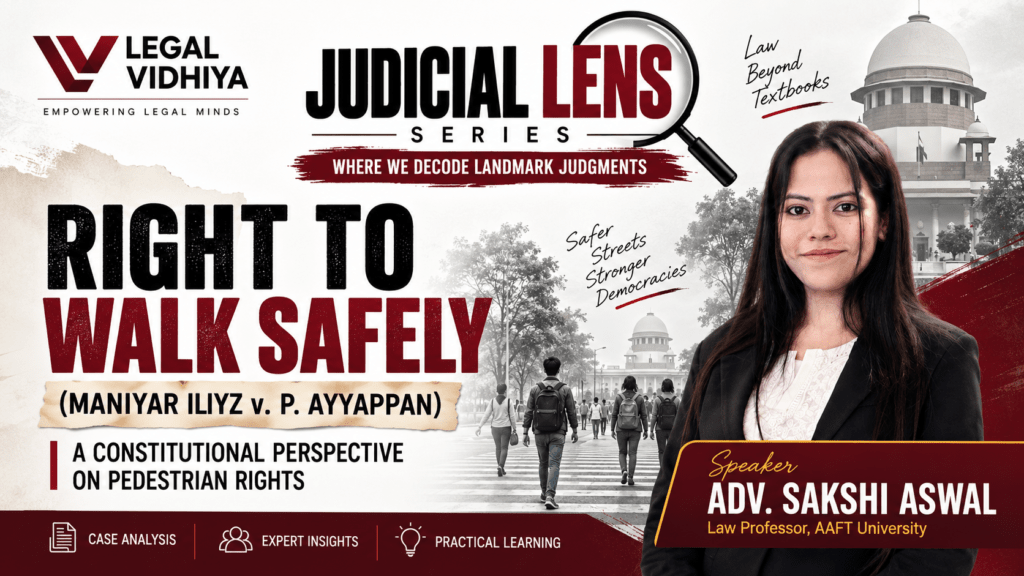


Judicial Lens Series: Decoding Landmark Judgments
Understanding the Right to Walk Safely Through Maniyar Iliyz v. P. Ayyappan
Legal education is not merely about memorising statutes or case names. It is about understanding how courts interpret the law, develop constitutional principles and apply them to real-life situations.
With this vision, Legal Vidhiya presents the Judicial Lens Series, a monthly legal learning initiative focused on decoding landmark judgments through interactive, mentor-led sessions.
The series aims to help law students and legal professionals understand judgments beyond their final orders by examining their facts, legal issues, applicable provisions, judicial reasoning, ratio decidendi and wider implications.
The Inaugural Session
The first session of the Judicial Lens Series focused on Maniyar Iliyz v. P. Ayyappan and examined an important constitutional question:
Does the Right to Move Freely under Article 19(1)(d) include the Right to Walk Safely?
The session explored the constitutional significance of walking and the responsibility of public authorities to ensure safe and accessible pedestrian infrastructure.
The discussion demonstrated how an everyday activity such as walking can raise significant questions concerning fundamental rights, public safety and constitutional governance.
Key Issues Explored
Right to Walk and Freedom of Movement
The session examined the relationship between the Right to Move Freely under Article 19(1)(d) and the ability of citizens to walk safely on public roads and pathways.
The discussion focused on how constitutional freedoms must have meaningful application in everyday life and how access to safe pedestrian infrastructure forms an important part of this understanding.
Responsibility of Public Authorities
A significant part of the discussion concerned the correlative duty of public authorities.
Municipal corporations, urban development authorities, panchayats and other public bodies have an important role in creating and maintaining pedestrian infrastructure. The session examined the need to ensure that urban development and road infrastructure do not overlook the safety and accessibility of pedestrians.
Road Safety and the Legal Framework
The session also considered the role of the Motor Vehicles Act, 1988, and the broader regulatory framework governing road safety.
The discussion highlighted the need for appropriate standards, maintenance mechanisms and effective enforcement concerning pedestrian infrastructure and protection.
Walking and Other Constitutional Freedoms
The constitutional significance of walking extends beyond mobility.
The session examined its connection with other freedoms guaranteed under Article 19, particularly the freedom of speech and expression under Article 19(1)(a) and the right to assemble peacefully under Article 19(1)(b).
The discussion also placed walking within the wider historical and social context of India, where marches and peaceful walks have often formed an important part of public expression and democratic participation.
Individual Justice and Compensation
Alongside the broader constitutional questions, the session also examined the individual dispute arising from a motor accident involving the death of a five-year-old child.
The discussion therefore connected the constitutional principles considered by the Court with the question of compensation and individual remedy, demonstrating how constitutional reasoning can coexist with the resolution of a specific legal dispute.
The Mentor
The session was led by Adv. Sakshi Laswal, Law Professor at AAFT University.
With experience spanning academia, legal research and practice, she brings a multidisciplinary perspective to legal education. Her professional background includes experience with reputed law firms such as Khaitan & Co. and IndusLaw, academic work at AAFT University, IPR-related work and advanced intellectual property training from Harvard and WIPO.
Her interactive approach enabled participants to engage with the judgment not merely as a case to be studied, but as a legal problem requiring analysis and application.
Why Judicial Lens is Important for Law Students
Landmark judgments form the foundation of legal education, but effective case-law learning requires more than memorising names and legal principles.
Through the Judicial Lens Series, students are encouraged to develop the ability to:
- Identify the material facts and legal issues of a case
- Understand relevant constitutional and statutory provisions
- Follow the Court’s reasoning and analytical approach
- Identify the ratio decidendi of a judgment
- Understand the wider implications of judicial decisions
- Apply case law to hypothetical and real-world situations
- Improve legal research and analytical skills
- Strengthen preparation for examinations, moots and academic writing
- Develop the habit of engaging with contemporary judicial developments
The inaugural session also included a scenario-based interactive quiz, allowing participants to apply the principles discussed during the session.
About Legal Vidhiya
Legal Vidhiya focuses on the overall development of legal minds and the wider dissemination of legal knowledge.
Through educational initiatives, webinars, workshops, internships and research opportunities, Legal Vidhiya aims to create an environment where students and legal professionals can learn, engage and develop practical legal skills.
The Judicial Lens Series forms part of this broader vision by bringing landmark judgments into an accessible and interactive learning environment.
A Monthly Initiative
The Judicial Lens Series will continue as a monthly initiative, with each edition focusing on an important judgment and providing participants with an opportunity to learn directly from experienced mentors.
The objective is not simply to answer what the Court decided, but to explore:
Why did the Court decide it?
How did the Court reach its conclusion?
What impact does the judgment have on the development of law?
How can students apply this understanding in their own legal work?
By approaching judgments through these questions, Legal Vidhiya seeks to make case-law learning more analytical, practical and engaging.
Watch the Full Session
The complete inaugural session on Maniyar Iliyz v. P. Ayyappan is available on YouTube.
Watch the full Judicial Lens Series session:
Watch on YouTube – Right to Walk Safely | Maniyar Iliyz v. P. Ayyappan

Judicial Lens Series
Where We Decode Landmark Judgments.
Legal Vidhiya — Empowering Legal Minds and Spreading Legal Knowledge.

