




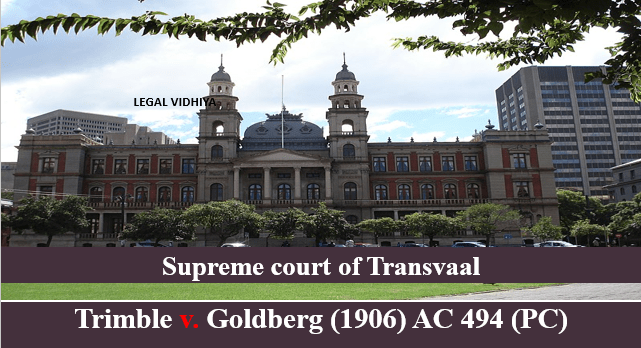
| CITATION | (1906) AC 494 (PC) |
| DATE OF JUDGEMENT | 16 July 1906 |
| COURT | Supreme court of Transvaal |
| APPELLANT | TRIMBLE AND BENNETT |
| RESPONDENT | GOLDBERG |
| BENCH | The Earl of Halsbury, Lord Macnaghten, Sir Arthur Wilson, Sir Alfred Wills |
INTRODUCTION
A noteworthy case heard by the US Supreme Court is Trimble v. Goldberg 1906. In front of Smith J., the case was tried. All but one of the learned Supreme Court judges sided with the trial judge on all disputed factual issues and all disputed legal issues. In this case, a partnership between land speculator Goldberg, auctioneer Trimble, and merchant Bennet was involved. The partnership’s goal was to purchase and sell certain properties that belonged to Hollard, including 5500 shares of a business called Sigma Building Syndicate Limited that deals in selling stands of land.
The remaining two were to give Trimble their powers of attorney, and Trimble was to handle all transactions. The deal went off without a hitch. Afterwards, Trimble and Bennet quietly purchased land from the company at a reduced price. Given as the justification for this concealment was Goldberg’s unsuitability as a partner and his unstable financial situation. The Plaintiff brought a lawsuit.
FACTS OF THE CASE.
In this case the individuals involved formed a partnership in order to buy “stands of land” that would later be turned in a township to be sold afresh. The land was bought along with stock in a business that owned further properties nearby. When the partners were in Johannesburg to finalize the details of the partnership’s acquiring it, an individual among the partners acquired the remaining stands that company had himself after being shown. Even though he learned about the land while conducting partnership business and his purchase was a similar type of investment to the ones of the partnership, the other party was not held accountable as “the purchase was not within the purview of the partnership.” A good faith clause prohibiting a partner from buying property for their own use is an infringement of contract that is punishable by damages.
The partnership contract dated February 10, 1902, had nothing significant. Losses and gains were to be distributed evenly. All business involving the partnership’s assets was to be conducted through and through Trimble, to who the remaining partners had to grant powers of attorney. No partner was allowed to dispose of the assets or sell them of their stake without the written approval of his other partners. Under the statutes of the South African Republic, the Sigma Syndicate, whose official name was the Sigma Building Syndicate Limited, was initially established in 1896 with a restricted liability.
One day Trimble visited the stands owned by the Sigma Syndicate with Hollard. Trimble questioned Hollard about whether the syndicate would be selling the stands in Government Square as a group when they arrived there. Yes, Hollard replied, adding that he anticipated the board would be sold for around £120,000. When Trimble inquired about the terms, Hollard directed him to the secretary, Davis, who would, according to him, bring the issue before the board. It appears that the syndicate made some unsuccessful attempts to sell its stands.
Trimble immediately connected with Bennett and informed him that he believed the sale would generate revenue based on some top-secret information he had learned, which it appears would not hold up under scrutiny. He invited Bennett to participate in the speculation and made it clear that he was willing to offer an even higher sum. Bennett agreed to support the business financially and to join. Trimble was able to obtain the stands on Government Square to himself and Bennett because the leadership of the syndicate were more than happy to accept his offer.
At the time, Goldberg was not made aware of this acquisition. It wasn’t until towards the end of 1902 or early in 1903 that he learned about it. According to Trimble’s undisputed testimony, which was backed up by an accountant named Winship who was present, he claimed to have met Trimble once in the street. But he had a loftier conception of his privileges, and in June 1904, he filed this lawsuit, initially claimed which the company had given Trimble the go-ahead to purchase the stands on a joint account—a claim that both Courts found to be unproven. He further argued that he possessed the right to split the profits from their purchase with his partners based on basic principles that applied to all partnerships.
The Court of Justice granted his claim on this basis. Their Lordships believe the Court of Appeal’s decision is ill-founded. The acquisition fell outside of the partnership’s purview. The object of purchasing was not a component of the partnership’s operations, a venture that competed with the activities of the partnership, or even remotely associated with it in any meaningful way. Furthermore, Trimble’s association of the Sigma Syndicate did not exonerate him from the knowledge upon which it appears he acted. Although the Court of Justice has noted that the method used to obtain the information was mostly to Trimble’s detriment, Goldberg is in no position to complain about it.
The Court of Appeal’s learned judges also appear to place some emphasis on a clause in the Sigma Syndicate’s articles of association that reads, “Each share gives, in accordance with the granted shares, a right to an equal share in ownership of the company’s assets and in the sharing of profits.” But that clause doesn’t offer anything unique. It merely serves to accurately describe the status of each shareholder in each trading organization restricted by shares. It seems exorbitant to think that by leaving the field and declining to compete in an event that in fact increased the cost of the stands and thereby increased the worth of the Sigma shares, he would’ve advanced the partnership’s interests.
ISSUES RAISED
- Whether the purchase of ‘Stands’ made by Trimble & Bennett was within the scope of the Partnership?
- Whether the purchase was injurious to the common interest?
- Whether there was a breach of Good Faith?
- Can Goldberg claim share in profits?
CONTENTIONS OF THE PLAINTIFF
- Contended that Trimble had been instructed by the partnership to purchase the stands on a shared account.
- He had the right to the sale’s profits, which was standard practice in partnerships.
- Supreme court – Due to an equity ruling in his favor, the Plaintiff has the right to a portion of the profits obtained by the different party that made a secret purchase.
- High Court – in favor of the Defendant
CORRELATIONS OF CASES.
- The disputed transaction was not a component of the partnership, an endeavor in direct competition with the partnership, or even remotely related to it.
- The Court of Appeal’s judgment received criticism. Although such buying was not specifically forbidden by the contract, the Court of Appeals ruled that it violated trust, the fundamental tenet of a partnership. The House of Lords conducted an analysis and determined that even if it had been expressly forbidden, the only possible remedies would have been a quick split of the partnership or a claim for damages. The proceeds from such a purchase, however, might have been considered out of scope.
- In one of the previous instances, Lord Blackburn made the observation that it is preferable in a partnership for reasons of caution and other considerations that everything be done legally and ethically. However, in this instance, although Goldberg had the legal authority to participate in speculation, Trimble or Bennet were not required by law to inform him of the investment.
- Additionally, as a shareholder of the company, the partnership ultimately benefited from the acquisition as the company was able to sell at a better price compared to what it might have received from the government.
JUDGEMENT.
The Privy Council ruled that the Court of Appeal’s ruling could not be upheld since it could not be justified by either precedent or any accepted equity doctrine. The purchase was deemed to be “not within the scope of the partnership” notwithstanding the fact that the appellant learned about it while conducting the partnership’s business or which was an identical transaction to that of the partnership.
The association among the partnership along with the partner’s acquisition has been perhaps nearly identical as it is here. The order that is the subject of the appeal, in their Lordships’ judgement, cannot be justified by precedent or by any accepted equity doctrine. Since the case should be reinstated and the review from the decision should be dismissed with costs, Their Lordships will respectfully encourage His Majesty to do so. As a result, the appeal was granted, and the responding party was ordered to cover the appeal’s costs.
CONCLUSION
To conclude, the case underscores partners owe each other duty of the utmost good faith Key elements of duty mean no conflicts of interest and no secret or profit, so full relevant disclosure is also vital. Codification of duties under S28-S30 Partnership Act 1890. Hence, the Appeal was allowed, and the Respondent was directed to pay the cost of the Appeal.
REFERENCES
- https://lexpeeps.in/trimble-v-goldberg-1906-ac-494-pc/#:~:text=Brief%20Facts%20and%20Procedural%20History&text=Later%2C%20Trimble%20along%20with%20Bennet,instituted%20by%20the%20Plaintiff%2FRespondent.
- https://dullbonline.wordpress.com/2017/06/29/trimble-v-goldberg-1906-ac-494-pc/#:~:text=Goldberg%20(1906)%20AC%20494%20(PC),-Posted%20on%20June&text=LORD%20MACNAGHTEN%20%E2%80%93%20This%20is%20an,took%20place%20before%20Smith%20J.
This Article is written by Simran Haider Pathan, student of Balaji Law College of Pune, Maharashtra, Intern at Legal Vidhiya.

