




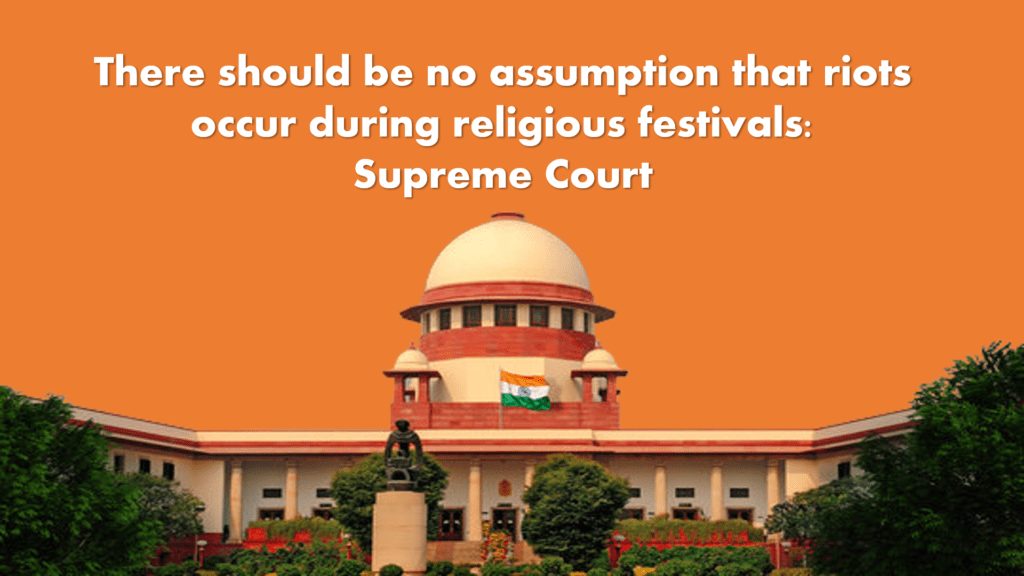
Therefore, the court dismissed a public interest litigation (PIL) seeking to regulate religious processions and establish a standard operating procedure for them.
On Friday, the Supreme Court of India criticized the sentiment to link religious processions with communal riots.
Chief Justice of India (CJI) DY Chandrachud and Justice PS Narasimha stated that even though millions of people come for Ganesh Puja in Maharashtra, there are no riots connected with the event.
“Why do we constantly want to portray religious festivals as times of violence? Let’s look at the good that occurs in the country. During Ganesh Puja in Maharashtra, millions of people gather, but there are no riots,” the CJI said.
In consideration of this, the Court dismissed a public interest litigation (PIL) seeking to control religious rallies and establish a standard operating procedure for the same.
The Court ruled that the prayers in the PIL are not judicially manageable because the subject issue is a concern for the State, and as such they cannot intervene.
“It is a State matter, and from Kashmir to Kanyakumari, the issues are different. How can this court monitor this? Prayers are not judicially controllable. It seeks a roving writ of mandamus, and law and order are within the domain of the State,” the Court said.
During today’s hearing, Senior Advocate CU Singh, counsel for the petitioner, stated that only the Supreme Court can prevent violence and rioting at religious meetings and processions.
Singh argued, “I myself have been through these commissions of inquiry. We are in the process of establishing criteria for how these approvals are granted. Currently, processions with swords and other weapons are held at religious festivals.”
However, the Court emphasised that it cannot intervene and that individual complaints must be reviewed by the relevant High Court.
The country is diverse, and concerns in one district of a state are distinct from those in another district; hence, the state has the authority to govern such matters.
The panel emphasised that the Supreme Court cannot be dragged into every aspect of law and order administered by the state.
Singh subsequently attempted to withdraw the appeal, but the court denied his request.
The Court ruled, “Sorry, but there is no withdrawal with these petitions. Dismissed.”
Written By: Lakshman Singh, B.B.A LL.B (Hons.), Shri Ramswaroop Memorial University, Lucknow

