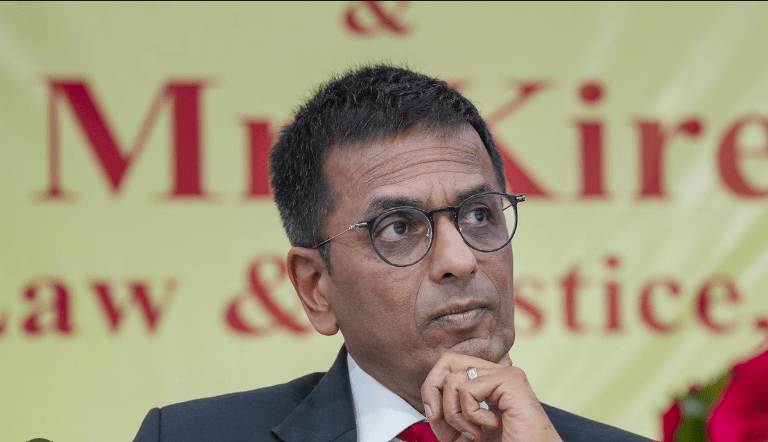
In order to “declog” Indian courts and promote an alternative, collaborative, interest-based conception of justice, the Chief Justice of India, DY Chandrachud, emphasized on Friday that the union government must switch from adversarial litigation to alternative dispute resolution methods, particularly mediation. The judge of the Supreme Court said:
“The Head legal officer for India made two declarations. Although I awaited the third announcement, which never came, I was delighted to hear them. Although I am no longer eligible to run as a shadow attorney general due to my position, I am still able to make the third announcement, which is that the motto of the union government and its agencies ought to be “Mediate, don’t litigate.”
At the National Conference on Mediation’s inauguration, Justice Chandrachud was giving the presidential address on the subject of “Mediation: “At the Beginning of a Golden Era” Under the direction of the National Legal Services Authority (NALSA) and the Mediation and Conciliation Project Committee (MCPC) of the top court, the event was organized by the Delhi High Court Mediation and Conciliation Centre, or “Samadhan.” Sanjay Kishan Kaul, PS Narasimha, Ahsanuddin Amanullah, Rajesh Bindal, Satish Chandra Sharma, Chief Justice of the Delhi High Court, and other high court judges, as well as R Venkataramani, the Attorney General of India, were also present.
The Indian Constitution was built on the foundation of dialogue, negotiation, compromise, and the creation of a consensus. Essentially, intervention is a cycle that includes settling conflicts by working with an open exchange, common comprehension and uniting partners with contrasting perspectives,” Equity Chandrachud said, making sense of that constitution drafting and intercession might appear to be inconsequential, however share ‘regulating’ objectives. He continued, “The goal is to create a framework that is inclusive and reflective of the values and aspirations of the people involved in both cases.”
The chief justice extolled the virtues of mediation and stated that it had a significant message for all citizens, particularly in today’s turbulent times. He inquired, “Would we say we are losing the capacity to converse with one another across the range? Is it becoming harder for us to have rational conversations? Furthermore, is it excessive, thusly, that we get something from intervention which is, being great audience members, grasping the others’ perspective, and not just demanding that the doctrine which we embrace is the main authoritative opinion which is applicable to the times?
Justice Chandrachud stated, “The ‘transformative’ characteristic of mediation was that it empowered those involved in disputes to determine not only the outcomes of their disputes but also the criteria and standards by which those outcomes are evaluated.” This empowered ordinary people to make decisions. Being the most un-formal of question goal components, he further said, intercession could give ideal and reasonable equity to all and lessen the weight of the expanding legal caseload. He Mediate, Do Not Litigate: CJI DY Chandrachud’s Message to Association Govt to ‘Declog’ Courts likewise said, “In purviews like India where we hold values like trust, local area, social concordance, and great relations on a high platform, intervention’s capacity to conceive an elective origination of equity which is more customized, comprehensive, and majority rule, can’t be put into words.” Added he:
“When viewed in this light, mediation has the potential to transform our understanding of justice itself, moving away from an adversarial formal process geared toward a zero-sum outcome and toward a process that is more collaborative and interest-based and focuses on enabling parties to move forward in a constructive manner. In other words, mediation is much more than a movement to clean up the courts.
The chief justice added that the government, the largest litigant, sent a message that “in the framework of the law, the government was not an adversarial opponent to our citizens” by choosing mediation over litigation. “The government must adopt the robes of a friend, partner, and a problem solver, whether in terms of business, communities, or families,” he said with emphasis.
SRISHTI BHARDWAJ, BCOM LLB 8TH SEM