




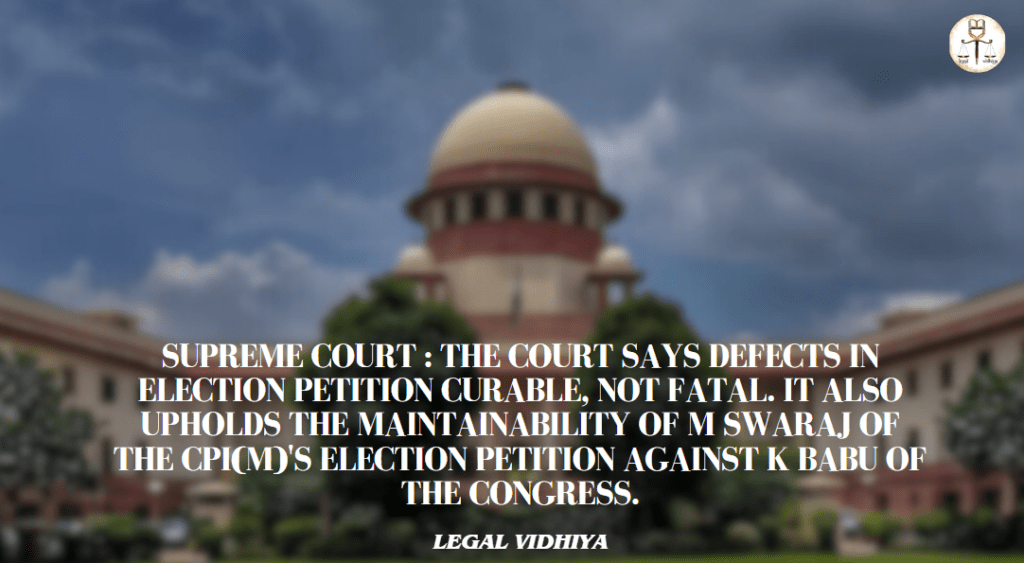
In the case of Congress MLA K Babu’s 2021 election to the Kerala legislative assembly from the Thrippunithura constituency, Communist Party of India (Marxist) leader M Swaraj filed an election petition against the latter. On Monday, the Supreme Court affirmed the petition’s maintainability. According to the Supreme Court, defects in an election petition that result from non-compliance with Section 83 of the Representation of the People Act, 1951 (Act of 1951) are curable.
Justices Aniruddha Bose and PV Sanjay Kumar mentioned“….the objections raised by the appellant against the maintainability of the election petition filed by the first respondent had no merit and the order of the High Court holding to that effect warrants no interference”.
In 2021, Babu won the election from Thrippunithura, narrowly defeating Swaraj by 992 votes. Claiming Babu had solicited votes in connection with the Sabarimala controversy, Swaraj urged the court to declare Babu’s election to be invalid. The respondent filed an Election Petition with the Kerala High Court under the Representation of the People Act, 1951 (the Act of 1951), requesting that the appellant’s election be ruled invalid and that he be declared legitimately elected as a result. Preliminary objections were made by the appellant, who claimed that copies of the documents served on respondents in the election petition were not authentic copies and had not undergone attestations. However, the appellant failed to provide a copy of the petition to support this claim.
After sending notice in July 2021, the Kerala High Court determined that the lawsuit needed to be heard first on the maintainability issue.
Babu’s instant appeal before the top court was initiated when Justice PG Ajith Kumar ultimately supported the maintainability of the plea. The dispute was brought before the Supreme Court in July of last year, and the proceedings before the High Court were thereafter halted until the appeal was resolved.
Babu had argued that the election petition was submitted after the statute of limitations had passed and that it omitted important information on corrupt electoral methods. It was noted by the court that the appellant had made a general
statement without providing any context about the concern regarding providing true copies.
The court explained that “In his grounds in the present case, the appellant stated that copies of the documents served on the respondents in the election petition were not true copies and had not been attested as such. However, a precise averment was not made by the appellant even before us that the copy of the petition supplied to him was not attested by the first respondent under his own signature to be a true copy of the election petition. Significantly, the copy of the petition furnished to him was neither produced before the High Court nor before us to substantiate this plea. In effect, the only point urged by the appellant is that the election petition is liable to be rejected for non-compliance with the requirement of Rule 212 of the Rules of 1971”.
The Division Bench noted the High Court’s conclusions about the slips that the appellant and his election agents distributed right away. According to the High Court, the same included a picture of Lord Ayyappa and made a vote-for-the appellant appeal. Additionally, it was noted that the appellant’s purported remarks did not automatically amount to corrupt behavior. But it would be corrupt to claim that someone used religious symbols to influence the election.
CASE NAME : K. Babu v. M. Swaraj and others
NAME :RIYA KRISHNA , COURSE : BBA LLB Hons , COLLEGE :MAHARASHTRA NATIONAL LAW UNIVERSITY, AURANGABAD, INTERN UNDER LEGAL VIDHIYA.
Disclaimer: The materials provided herein are intended solely for informational purposes. Accessing or using the site or the materials does not establish an attorney-client relationship. The information presented on this site is not to be construed as legal or professional advice, and it should not be relied upon for such purposes or used as a substitute for advice from a licensed attorney in your state. Additionally, the viewpoint presented by the author is of a personal nature.

