




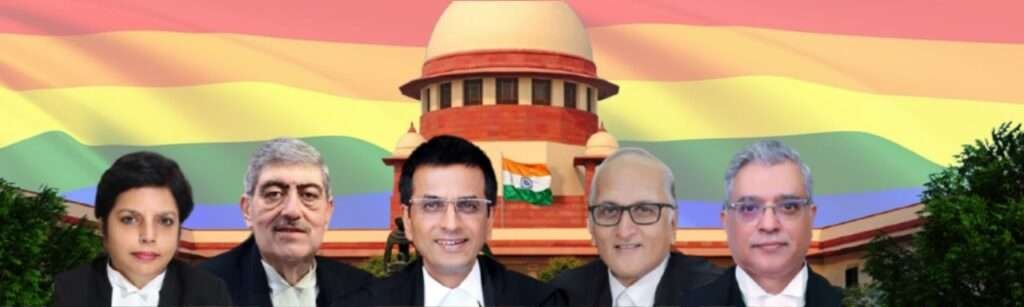
Today, a five-judge panel of the Supreme Court, led by Chief Justice of India DY Chandrachud, consisted of Justices Sanjay Kishan Kaul, Ravindra Bhat, Hima Kohli, and PS Narasimha. delivered a unanimous decision opposing the legalization of same-sex marriages in India. Additionally, the bench issued a 3:2 verdict against permitting civil unions for non-heterosexual couples. However, all the judges on the bench agreed that the Union of India, as per its earlier statement, shall constitute a committee to examine the rights and entitlements of same-sex couples.
CJI DY Chandrachud and Justice Sanjay Kishan Kaul expressed dissenting opinions, opposing the majority’s decision to deny recognition of the rights of same-sex couples to marry or enter into civil unions.
“The right to enter into a union cannot be restricted based on sexual orientation. Such a restriction will be violative of Article 15. Thus, this freedom is available to all persons regardless of gender identity or sexual orientation,” they said. The CJI and Justice Kaul, however, also ruled that it would be within the domain of Parliament to give legal recognition to same-sex marriages.
CJI DY Chandrachud affirmed that the court recognizes the right of same-sex couples to pursue recognition of their unions. He emphasized that the Constitution guarantees the freedom of the same-sex community to form such unions. However, the CJI held that the Court cannot strike down or read down the provisions of the Special Marriage Act owing to “institutional limitations” as the same would fall within the domain of the Parliament and the Legislature.
Furthermore, he stated that unmarried couples, including those in same-sex relationships, should have the right to jointly adopt a child. In this context, the Chief Justice of India (CJI) found that Regulation 5(3) of the CARA Regulations, which prohibited unmarried and same-sex couples from adopting, were in violation of Article 15 of the Constitution. Justice SK Kaul concurred with the judgement of the CJI and while stating that same-sex unions “are to be recognized as a union to give partnership and love”. Justice SK Kaul stated that the Special Marriage Act was discriminatory and violated Article 14 of the constitution. However, like the Chief Justice, Justice Kaul also acknowledged that there were constraints on the court in incorporating same-sex unions into the Special Marriage Act, as this was a matter for the Parliament to decide.
The judges also said that the Central and state governments and the administrations of union territories shall not discriminate against the freedom of same-sex couples to enter into union with benefits under law.
Justice S Ravindra Bhat held a differing opinion from the Chief Justice’s judgment, asserting that the recognition of civil unions should only be achieved through a legislated law. Nevertheless, in line with the Solicitor General’s statement to the Court, Justice Bhat also reached the conclusion that the Union government should establish a High-Powered Committee to assess the rights and privileges of same-sex couples. He argued that marriage is a “social institution” and cannot be considered an absolute, unrestricted right that should be treated as a fundamental right. Justice Bhat held– “All queer persons have the right to choose their partners. But State cannot be obligated to recognize the bouquet of rights flowingfrom such a Union. We disagree with the CJI on this aspect.” Justice Hima Kohli concurred with Justice Bhat.
The majority of Justices Bhat, Kohli, and Narasimha asserted that, according to the law, civil unions between same-sex couples are not acknowledged, and as a result, these couples do not have the legal right to adopt children.
“All the judges were unanimous in holding that there is no unqualified right to marriage and same-sex couples cannot claim that as a fundamental right”.
Determining the recognition of same-sex unions falls under the jurisdiction of the Legislature, but the government might need to guarantee that social, legal rights, and other benefits are provided to same-sex couples even if the term “marriage” is not used. Courts cannot decide on issues based on young people’s sentiments. Marriages are entitled to constitutional and not just statutory protections.
Written by- Pradyumn sharma.
REFRENCES
- https://www.barandbench.com/news/supreme-court-says-no-same-sex-marriage-civil-union-cji-civil-unions-same-sex-couples-minority-opinion
- https://indianexpress.com/article/explained/explained-law/sc-verdict-on-same-sex-marriages-explained-live-8986361/
- https://www.livelaw.in/top-stories/supreme-court-same-sex-marriage-equality-queer-couple-240341?infinitescroll=1
- https://www.barandbench.com/news/same-sex-marriage-what-did-minority-judgment-supreme-court

