




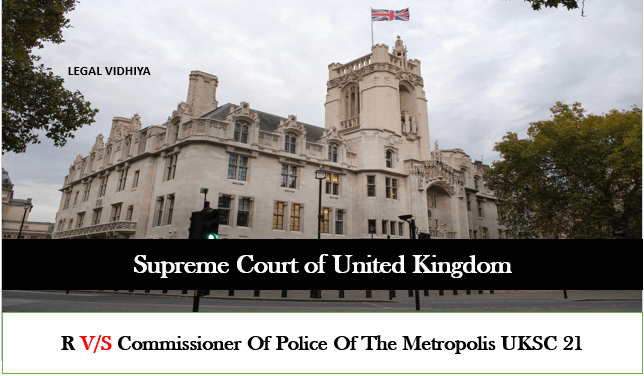
| Citation | (2015) UKSC 79/ 2014, 0138 |
| Date of Judgement | 18 May, 2011 |
| Court | Supreme Court of United Kingdom |
| Case Type | Human Rights, Respect to Private life, Police Powers |
| Appellant | R (on application of GC) |
| Respondent | Commissioner of Police of Metropolis |
| Bench | Lord Phillips, Lord Rodger, Lady Hale, Lord Brown, Lord Judge, Lord Kerr, Lord Dyson |
| Referred | UK Supreme Court web |
Facts of the Case
If a person is not a party to a case then he shall not be tried for the same, similarly in this case the fingerprints or samples were to be destroyed of a person who was not in connection with the investigation of an offence as he was cleared of that offence, said section 64 of the Police and Criminal Evidence Act, 1984 (PACE). Section 82 of Justice and Police Act, 2001 was replaced by section 64 (1A) of PACE stating the statutory obligation to destroy data with a discretion. Section 64 (1A) provides that samples taken in connection with the investigation of an offence, “may be retained after they have fulfilled the purposes for which they were taken.”
In December 2007, GC was arrested on suspicion of common assault on his girlfriend and he denied the same. He was released on a police bail without any charges on him with a sample of his fingerprints and photographs and was subsequently informed that no further action would be taken against him. In March 2009 C was arrested on the allegation of rape, harassment and fraud. Further, finding no evidence against him C was acquitted by the Woolwich Crown Court in May 2009. In both the cases, the appellants requested the destruction of the data taken, with this the request was refused as there were no exceptional circumstances within the meaning of the ACPO guidelines.
Issues
The Supreme Court came up with the issue that
- Whether those data and samples of photographs and fingerprints shall be destructed or not?
Arguments
It was argued in the said dispute that the data collected of the suspicious people connected to the investigation of an offence shall be retained indefinitely, this premise of the Parliament was laid down to be the correct one as there is a requirement of sample of previous history sheeters so that any assistance if required that can be taken by that record so that victims can be prevented from the offence.
Judgement
It was observed by the honorable Supreme Court, the appeal was dismissed by the court unanimously and it was checked whether the appeal was within the scope of Article 8, it stated that no compromise shall be done in respect to private life, public information can fall into the scope of private life.
References
https://www.supremecourt.uk/cases/uksc-2014-0138.html
Written by Nehal Soni an intern under legal vidhiya
| Disclaimer: The materials provided herein are intended solely for informational purposes. Accessing or using the site or the materials does not establish an attorney-client relationship. The information presented on this site is not to be construed as legal or professional advice, and it should not be relied upon for such purposes or used as a substitute for advice from a licensed attorney in your state. Additionally, the viewpoint presented by the author is of a personal nature. |

