




Nobel Peace Prize laureate and UN Messenger of Peace, Malala Yousafzai, famously survived a Taliban assassination attempt while a teenager campaigning for girls’ education in her native Pakistan. “So now is the time that we stick to that commitment and ensure that their rights in government are protected. And one of those important rights is the right to education.”
Secretary-General of United Nations Security Council, Antonio Guterres even addressed the situation and the grievances happening in the Taliban and said, “These are the careers of the future, and we cannot achieve gender equality in our societies without women playing an equal role” and “addressing these issues means working to overturn deeply rooted stereotypes and social norms that see women and girls as less deserving of an education, or that limit which subjects they have access to”.
Bennoune also promoted and endorsed the education among the women of Taliban. “It is not enough for foreign governments to secure the safety of their own nationals”, said Ms. Bennoune. “They have a legal and moral obligation to act to protect the rights of Afghans, including the rights to access to education and to work, without discrimination, as well as the right of everyone to take part in cultural life.”
“Out in the rural communities, there is skills-building and there are community-based programmes, and we can do more with distance education and remote learning,” the UNICEF chief said. “We need to have women teachers going back to schools, and we need more women teachers.”
After putting so much efforts, women of Taliban still facing the issue regarding their rights, they started pulling away women’s rights. A large number of women were destitute from appearing in the examination hall.
A dozens of Afghan women’s rights activists and girl students Thursday staged a protest in Kabul, Takhar and Nangarhar provinces, demanding that women be allowed access to education and employment.
“We went to the university to give our exam; our male classmates were able to get in the hall, but we were not allowed by the armed Taliban forces. They kicked us out of the university with violence and cruelty, as if we had committed a huge crime. We have four exams left. What is going to be our future?” said one female student from Nangarhar University who asked not to be identified for safety reasons.
While protesting, at least five women and a couple of male protesters were arrested by the taliban’s security force.
One of the female protesters, who asked that her name not be used for fear of Taliban retaliation, told VOA, “The Taliban forces beat us up and arrested some of our female and male protesters and took them away. They scattered us apart. However, we will not let it go. We will fight for our rights.”
Women expressed their emotion regarding the situation appeared before them, on the day of their exams. “I had studied and prepared for my exam until very late that night. As soon as I woke up and saw the news about the ban, my dreams shattered. I started crying. Why are we treated as criminals? We have no respect and no values for these people,” said Bahar Ahmadzai, a student at Kabul Medical University.
the Taliban’s higher education minister, Neda Mohammad Nadeem, defended the decision in a post on Twitter.
“The Nation is angry with me because of the closure of girls’ education, while this is the order of the Messenger of Allah,” the tweet said. “Islam does not allow women to do prostitution in the name of education. A woman is like a piece of land owned by a man, and she is obligated to be at his service, not perusing education.”
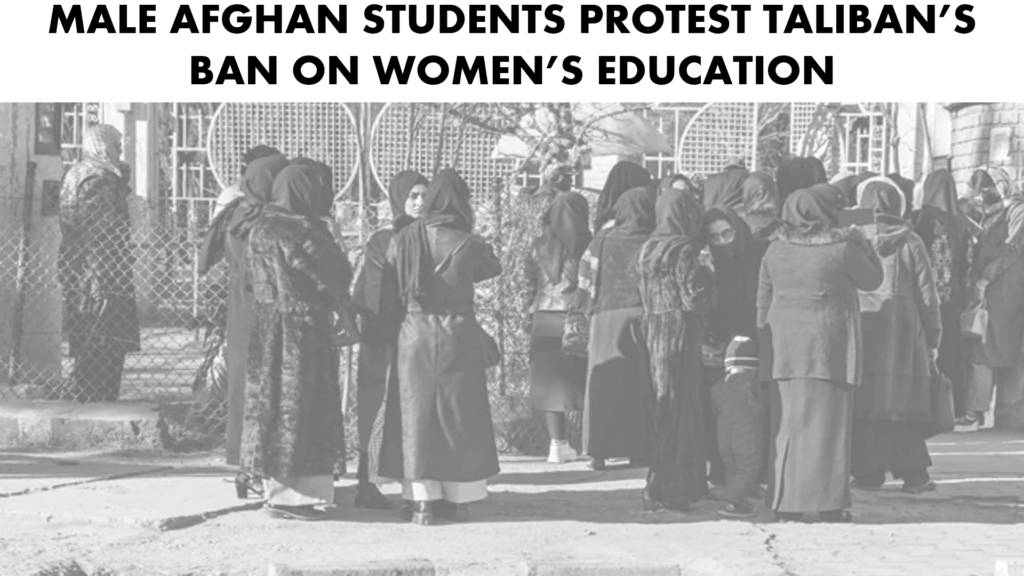
Many of them protested against the wrong and supported the women education and their appreance in the examination hall. In the eastern city of Nangarhar, some male university students also walked out of their exams in protest against the Taliban’s decision to ban female students from higher education.
One male student, who also declined to provide his name, said, “We did not attend the exam and we will not until our female classmates are allowed to take exams, too.”
Several male professors from various universities in multiple provinces resigned in protest.
Obaidullah Wardak, assistant professor at Kabul University, said, “I and some of my colleagues resigned in protest against this dark day. We will not return to the university unless the decision is revoked by the Taliban.”
Afghan writer and human rights activist Shafiqa Khpalwak called the ban on girls’ education a crime against humanity. She asked the international community and Islamic countries to step forward and help the Afghan women in this fight against extremism.
“This catastrophe does not only concern the rise of women but threatens the whole existence of our country,” she said. “The so called ‘international community’ is also responsible for the crisis and now they cannot look away from us, they cannot walk away from the mess they have created. We need them to come up with practical and pragmatic solutions that will eventually bring results for us.”
“Afghan women are alone in this fight against radicalism. They need help!” she added.
Lida Afghan, a Danish-Afghan artist whose art highlights social problems and women’s rights, said it is time for the world to stand with the Afghan women.
“I was supposed to focus on my exams today and then I got the news that Afghan women are banned from going to the university,” Lida said. “I thought: It could have been any of us if our parents hadn’t fled the country. In these tough times the whole world should be standing up for the Afghan women, knowing it could have been one of us.”
The Taliban have so far shut girls’ secondary schools; banned women from public parks, gyms and baths; imposed mandatory hijab “covering faces”; and imposed executions and harsh public punishments such as flogging.
Several countries including the United States and the U.N.’s mission in Afghanistan asked the Taliban leadership to “immediately” revoke the decision.
Similar videos were shared from Nangarhar Medical Faculty in Jalalabad and Kandahar University where men staged walkouts and joined protests against the university’s education ban on women.
BY: AYUSHI BHUSHAN, 1ST YEAR, BA.LLB(INTEGRATED), BANASTHALI UNIVERSITY, RAJASTHAN.

