




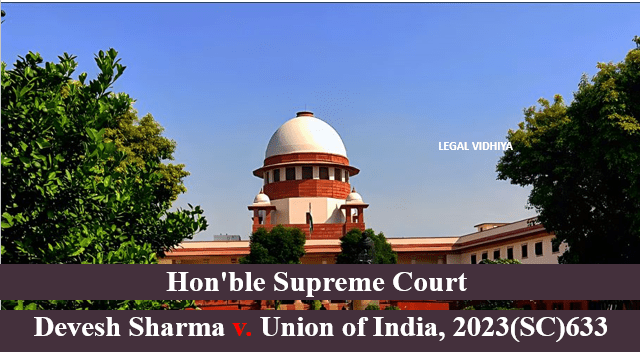
| Citation | 2023(SC) 633, 2023INSC 704 |
| Date of Judgement | 11th August 2023 |
| Court | Supreme Court of India |
| Case Type | Civil Appeal 5068 of 2023 |
| Appellant | Devesh Sharma |
| Respondent | Union of India & Ors. |
| Bench | Justice Sudhanshu Dhulia, Justice Aniruddha Bose |
| Referred | Article 21 of the Constitution of India, Section 23 of the NCTE Act. |
Facts of the Case
A judgment dated 25th November 2021, of the division bench of the Rajasthan High Court was challenged before this court. There were three more Writ Petitions on a similar matter before the court, rather than this appeal. While pursuing these cases, for facts, we would refer to a Civil Appeal arising out of a special leave petition (C) No. 20743 of 2021 Devesh Sharma v. Union of India which become apparent out of the order dated 25, November 2021 and was passed by the High Court in Division Bench Civil Writ Petition No.2109 of 2021.
The essence of the conflict involves a notification issued by National Council for Teachers’ Education (NCTE). According to such notification all the applicants or candidates who are B.Ed. degree holders were qualified or acceptable for the post of primary school teachers i.e., for the classes of 1 to 5. Although while advertised the Rajasthan Teacher Eligibility Test (RTET) was by the Board of Secondary Education, the State of Rajasthan from the list of eligible applicants or candidates, B.Ed. degree holders were eliminated. This conduct of eliminating candidates or applicants of the Government of Rajasthan was questioned before the High Court of Rajasthan. The High Court of Rajasthan suppress the notification of the NCTE and held that the B.Ed. degree holder applicants or candidates were restricted and not qualified for the post of primary school teacher.
Issues
- Whether the candidate’s B.Ed. degree holders are eligible to provide Quality Education to primary school children or not?
- Whether the order of the High Court ignored the powers of the central government under the NCTE Act?
- Whether the Judicial Review can be exercised against the policy guidelines clashing law?
The contention of both sides
Senior Advocates Meenakshi Arora and Advocate P S Pal Walia appeared in the court from the side of the appellant who was the B.Ed. qualified applicants and argued that the High Court was not successful to acknowledge that the notification issued by the National Council for Teachers Education (NCTE) was the policy instructions after the Central Government had provided all the related guidelines and the High Court was unnecessarily interrupting with the guidelines of the policy issued by the Central Government.
ASG Vikramjeet Banerjee and ASG Aishwarya Bhati appeared in the court for the Union of India and argued that the challenged order was not passed keeping in view the powers of the Central Government. The powers of the central government were ignored given under NCTE. And this was also objected that even the Union of India was not made a party in any court proceedings before the High Court of Rajasthan.
Court Observation
Focusing on the object of Article 21 of the Indian Constitution and the Right to Education Act the Supreme Court said that some definite rules, regulations, and levels had to be set down by the Act which must be abide by the elementary schools for the intention of accommodating relevant and quality education to the children. Later, a notification brought by NCTE dated 23,08,2010 was amended but still, B.Ed. was excluded as a necessary qualification for the post of primary school teacher. The challenged order of the High Court had not ignored the powers of the Central Government. The court further added that the policy guidelines submitted by the Central Government could not obstruct, the court
held that if the policy guidelines itself oppose the law and is vague in nature and unreasonable or illogical in that case the power of judicial review must be exercised. It was further held that the notification simply followed all the directives of the Central Government, it was not a self-sustaining decision of the NCTE taken by proper consideration.
Judgement
Therefore, the appeal is declined and the decision of the High Court of Rajasthan was upheld. The notification dated 28,06,2018 was rejected and set aside.
Reference
Written by Vipasha Mehta, Intern at Legal Vidhiya

