




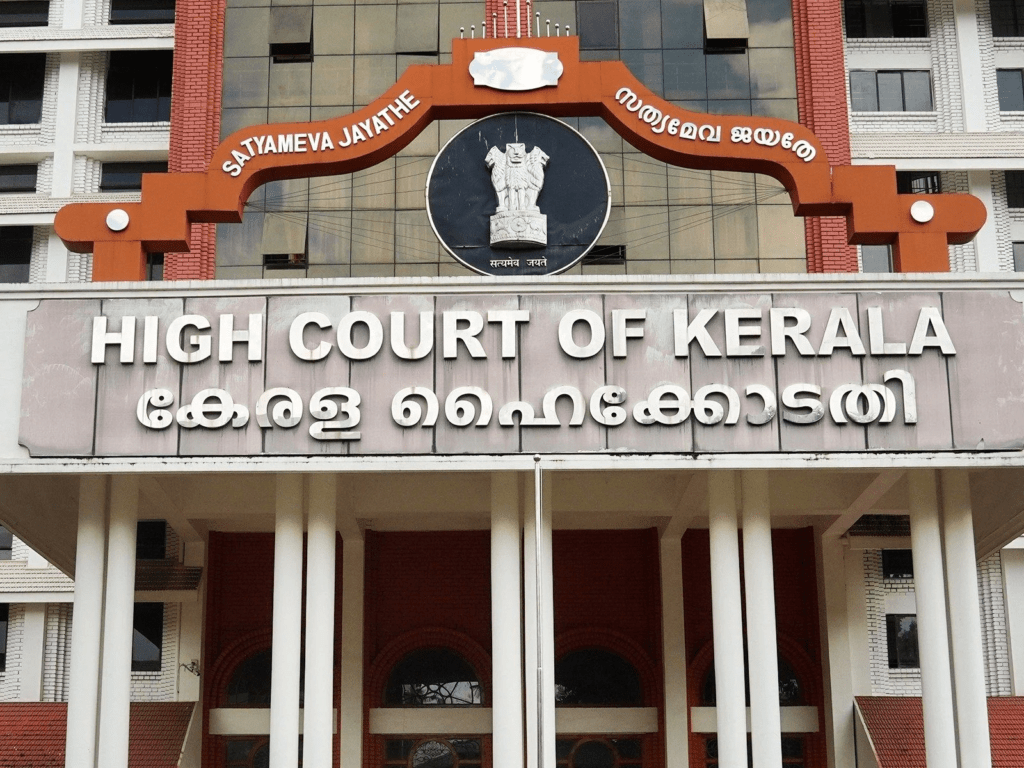
A CRPF member has appealed speeding tickets that were allegedly handed to him after the statutory window had closed to the Kerala High Court.
On Friday, the Single Judge Bench of Justice C.S. Dias acknowledged the situation and ordered the Government Pleader to seek guidance.
On March 5, 2023, the petitioner in this case received two e-challans for driving above the posted speed limit twice on September 28, 2022, as determined by an AI camera. Verification revealed that the driver of the car on the specified day was the petitioner’s son.
The two e-Challans, according to the petitioner, were issued in flagrant disregard of many sections of the Motor Vehicles Act and the Central Motor Vehicles Rules, 1989 (hereafter, “CMVR”). According to Rule 167A (9) of the CMVR, notice of the offence must be sent within 15 days after the incident, however in the instant case, the petitioner didn’t get the notification until over 6 months after the claimed speed violation.
Further, it was claimed that the challan should have been accompanied by a certificate issued in accordance with Section 65B(4) of the Indian Evidence Act, 1872, as required by Rule 167A(6)(v), but that need was not met in this case. Therefore, the petitioner claimed that the aforementioned notices were “coated with discrepancies”.
The petitioner said that after becoming aware of the errors, he approached the Transport Commissioner with his concerns. He also aimed to draw their attention to the part of the National Highway that lacked signs and safety precautions. The petitioner claims that RTO has acknowledged the delay in issuing the notices, which was caused by the updating of the software and data for parivahan seva. However, the petitioner claimed that RTO sought to claim that the National Highway Authority of India (NHAI) and not the Motor Vehicles Department (MVD) had jurisdiction over the road safety markings and signage.
“It is submitted that though, statutorily it may be the responsibility of the NHAI, the 1st Respondent (RTO) cannot walk away from its moral and ethical responsibility in seeing to it that the NHAI or the concerned authorities are notified about the lack of safety measures and signages on such a stretch of road, where chances of speeding is high and consequently higher the chances of accidents. And, furthermore, the 1st Respondent and its parent authorities, the 2nd Respondent (Transport Commissioner) and 3rd Respondent (State of Kerala represented by Secretary, Department of Transport), cannot merely wash of its hands from installing and implementing the various safety measures as envisaged under the Motor Vehicles Act and the various rules framed thereunder. This is more so when the electronic enforcement speed cameras are installed by the 2nd Respondent and is being used by it as a milking tool for generating revenue,” the plea sstates
Written By- Aditya Singh, College Name- Army Law College, Pune, Semester- 2nd Semester Student an Intern under Legal Vidhya

