




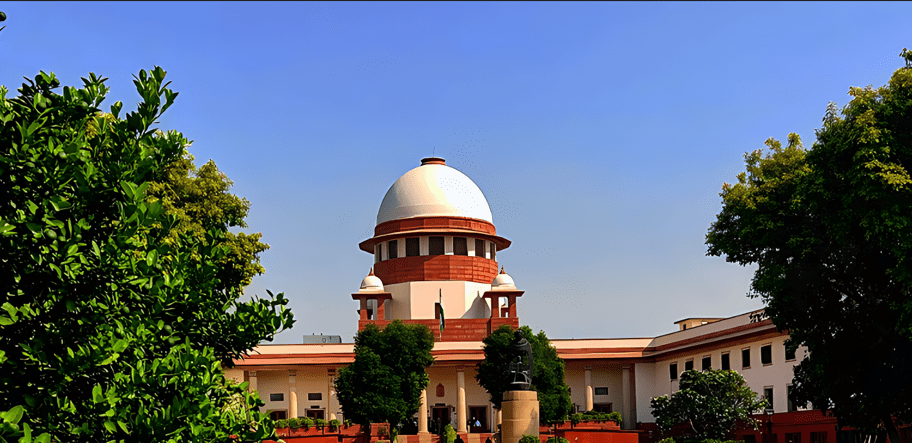
The Supreme Court on Monday ruled that the complaint committees who are looking into the cases of sexual harassment happened at workplace are now empowered to put questions before the witnesses during the course of inquiry proceedings.
A bench of CJI DY Chandrachud with Justices JB Pardiwala and Manoj Misra emphasized that such proceedings are analogous to judicial proceedings. The bench observed that, there is no logic appeared in order to restrict the power of complaint committee to put questions to the witnesses only to the context specified in the previously described provision. Being an inquiry authority and in some sense to a presiding officer to the court, complaints committee must be allowed to put questions in order to proper, fair and thorough inquiry is to take place.
The Supreme Court has made the observation while setting aside a Gauhati High Court’s decision, in which High Court had held that certain inquiry by complaint committee will stood vitiated as they put question to the prosecution witnesses.
The apex court while disagreeing with this approach said that, if the observations of the High Court are followed then the complaint committees will reduced into a mere recording machine and would lead to a chilling effect. We failed to understand the other purpose for which complaints committee is deemed to be an inquiry committee, if we are to follow that complaints committee cannot put questions to the witnesses.
The Court also emphasized that allowing sexual harassers to elude the law will humiliate and frustrate the survivor. The bench further added that, it should be remembered that the charge of this nature is very easy to make but very difficult to withdraw. When a plea is taken of false implications then it is the duty of the court to make a deep scrutiny of the evidence and decide the acceptability. Every care should be taken to separate the chaff from the grain.
The Top Court further alerted against misuse of the law under the guise of sexual harassment as such practice makes a joke of the justice system.
The case before the court concerned by a senior officer at the services selection board in Assam. A complaint was filed by a lady colleague against him and accused him of sexual harassment. Inquiries were conducted including central complaints committee. The Committee, later, found him guilty and as a punishment they recommended that his pension and retiral dues be cut by half as punishment, considering that he had retired during the course of inquiry proceedings.
The accused officer had been granted relief by the Gauhati High Court when he filed an appeal. The High Court also opined that the Committee had played the role of prosecutor in the case where there was no evidence.
The Central Government challenged the verdict of the High Court in the Supreme Court through an appeal, which has now been allowed. The SC recapitulated that in a disciplinary inquiry, the standard of proof is “preponderance of probabilities” and courts should only interfere when they are based on no evidence at all along with the findings of the disciplinary authority.
In this aforesaid case, the Court found that this is not the case of “no evidence” and that the complainant’s allegations had been proved by witnesses
Hence, SC allowed the appeal and recaptured the order of the penalty on accused by the Complaint Committee.
Central Government was represented by Advocate K Parameswar and Advocate Avjit Roy appeared for the accused.
Written by:- Dolly Singh Gehlot, College:- BM Law College, Jodhpur, Semester:- 5th an intern under Legal Vidhiya
Disclaimer: The materials provided herein are intended solely for informational purposes. Accessing or using the site or the materials does not establish an attorney-client relationship. The information presented on this site is not to be construed as legal or professional advice, and it should not be relied upon for such purposes or used as a substitute for advice from a licensed attorney in your state. Additionally, the viewpoint presented by the author is of a personal nature.

