




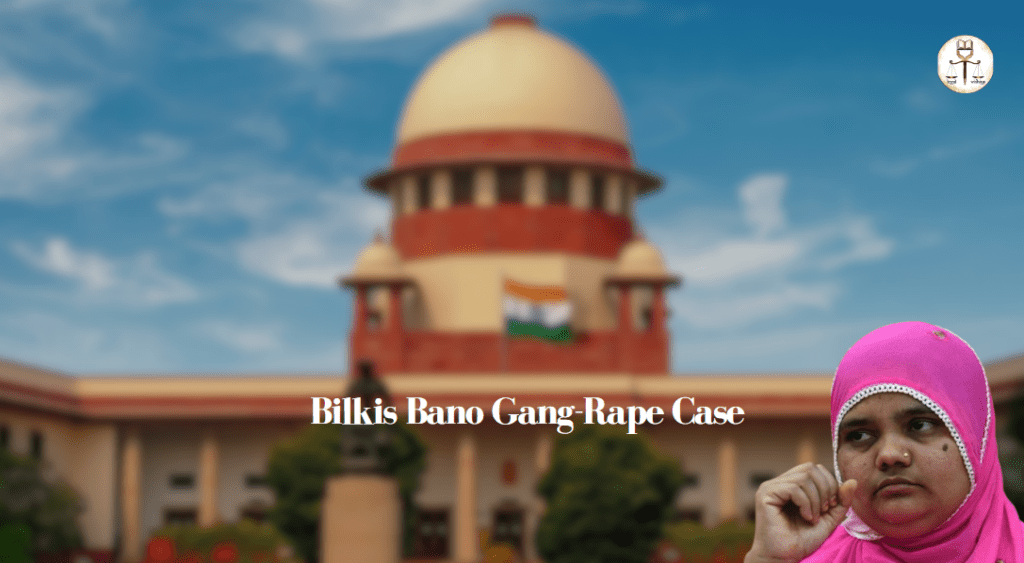
The case revolves around Bilkis Bano, a Muslim women raped during the Godhra riots in 2002 while attempting to escape with her family. Tragically, the violent mob not only raped her, being five months pregnant at the time, but also massacred her entire family. The incident sparked nationwide outrage. Eventually, a division bench led by Supreme Court judges KM Joseph and BV Nagarathna, convicted 11 individuals, sentencing them to life imprisonment due to the heinous nature of their crimes.
Several years later, in 2022, a group of 11 convicts received a “Special Remission” as part of the celebration of 75 years of Independence known as ‘Azadi Ka Mahotsav’. This led to their release from prison after serving a 14-year sentence, which caused distress not only to the victim, Bilkis Bano, but also drew opposition from numerous individuals across the nation. Bilkis Bano lodged a petition against the initial release of the convicts, disagreeing with the Gujarat Government’s decision.
Background of the case
During the communal riots in Gujarat on March 3rd, 2002, in Dahod district, Bilkis Bano, a 21-year-old pregnant woman, and other female relatives were subjected to gang rape. Tragically, along with her ordeal, seven of her family members fell victim to murder at the hands of the perpetrators.
Bilkis Bano alleged that the police omitted crucial details necessary for the FIR registration. Faced with this obstacle, she approached the National Human Rights Commission (NHRC) and later petitioned the Supreme Court. The Supreme Court, upon her plea, ordered a CBI inquiry, resulting in the swift arrest of the accused within a month. However, during this period, the perpetrators threatened her life. Bano raised these death threats in the Supreme Court, prompting the decision to transfer the case from the Gujarat Court to Maharashtra Court for a more impartial investigation.
Laws relating to Remission
• When a convict receives a life sentence, they are expected to serve the entire duration in prison. However, both state and central governments can consider releasing convicts only after they have completed at least 14 years of
imprisonment through a process called remission. This process allows for a reduction in the prison term.
• Under the Indian Constitution, specifically Article 72 (President’s power) and Article 161 (Governor’s power), the President and Governor, respectively, possess the authority to pardon, suspend, remit, or commute a court-issued sentence. It’s crucial that such decisions are made judiciously and not arbitrarily.
• Section 432 of the Code of Criminal Procedure, 1973, empowers the State Government to grant remission and release prisoners since the management of prisons falls under the domain of state affairs.1
Case controversies
Responding to her plea, the Supreme Court mandated the Central Bureau of Investigation (CBI) to undertake an inquiry into the matter. The investigation agency apprehended all the accused in 2004. The trial was transferred from Ahmedabad to Mumbai over fears of evidence tampering.
13 individuals in the case were convicted on charges of rape, murder, and conspiracy, out of which 11 were given life sentences. These convicts then challenged their conviction in the Bombay High Court in 2008.
After several attempts to overturn the judgment and the CBI pushing for the death penalty, the High Court upheld its previous order of life sentences for 11 convicts in 2017.
Radheshyam Shah, one of the convicts, pursued legal avenues by approaching both the High Court and Supreme Court in 2022, seeking an initial release after having served 15 years, as reported by Outlook India. The Supreme Court transferred this case to the Gujarat government for consideration.
Subsequently, on August 15, 2022, the Gujarat government released all 11 convicts involved in the gangrape case based on its remission policy. However, this action triggered substantial public outcry and led to petitions from opposition MPs.
In 2022, Bilkis Bano filed an appeal in the Supreme Court urging a review of the Gujarat government’s decision to release the 11 gangrape convicts, questioning the validity of their release.
1 Upasana Sarkar, Bilkis Bano Case, https://blog.ipleaders.in/bilkis-bano-case/
The case was scheduled for hearing in the Supreme Court in March 2023, during which arguments from both the Central and Gujarat governments were heard. The Supreme Court also directed the state government to provide the original documents used as the basis for their decision.
Finally, on January 8, 2024, the Supreme Court ruled to reject the remission granted to the convicts involved in the Bilkis Bano gang rape case. The Court mandated that these convicts surrender to the authorities within two weeks.
Case Name- Bilkis Yakub Rasool vs. Union of India (2023)
Anshra Zafar, a B.A.LLB (Hons) student of IILM University, Greater Noida, 4th semester, an intern under Legal Vidhiya.

