




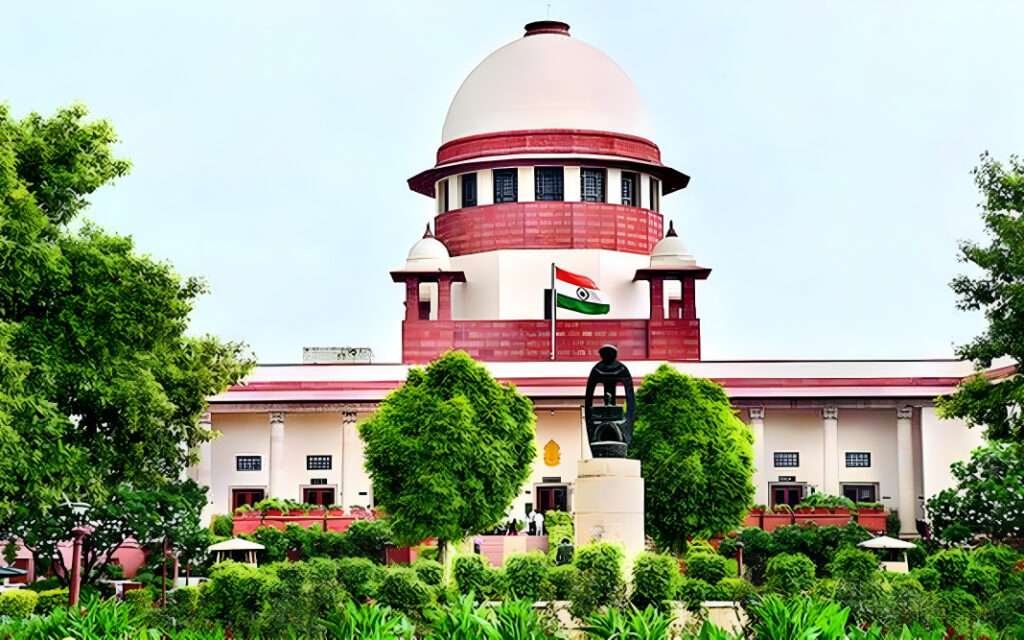
The Supreme Court made verbal observations on Thursday regarding the petitioners who were opposing the early release of convicts involved in the Bilkis Bano gang-rape case. The Court noted that these petitioners were not denied the right to approach the court just because the previous decision had left the matter of convicts’ release to the Gujarat government. A panel of Justices BV Nagarathna and Ujjal Bhuyan heard a set of pleas challenging the Gujarat government’s choice to grant remission to 11 convicts who were responsible for the gang rape of Bilkis Bano and the murder of her family during the 2002 Gujarat riots.
Justice Nagarathna addressed Advocate Rishi Malhotra, who represented one of the convicts, highlighting that the challenge was against the remission order that came after the initial writ petition. The Court emphasized that the act of challenging the remission was valid and not barred by the previous order. The Court also mentioned that there was a distinction between the orders and that the remission could indeed be questioned. Additional Solicitor General SV Raju, representing the Gujarat government, reaffirmed that all necessary procedures were followed before granting remission.
Malhotra argued that the 1992 Gujarat policy did not require a unanimous or majority decision, but only a compilation of views from stakeholders. He added that the unfavorable view from the Mumbai judge was based on their remission policy. Justice Nagarathna responded that the Mumbai judge’s view was not obligatory, but the Gujarat trial judge’s view was sought, even though he was part of the remission committee.
Malhotra pointed out that his client had studied and practiced law. Justice Bhuyan countered, questioning whether one could practice law after a conviction. Malhotra argued that his client had completed the sentence, but Justice Nagarathna noted that the conviction still remained.
Advocate Sonia Mathur, representing another convict, argued that once the sentence was reduced, the individual’s liberty couldn’t be denied. Justice Nagarathna clarified that the sentence itself persisted; it was just administratively reduced. The Court also raised questions about the implementation of remission and the overcrowding of jails.
Mathur emphasized that her client had served fourteen years in prison, asserting that his early release was earned rather than charity. The hearing was scheduled to continue on August 31 at 3 PM.
The Gujarat government had granted remission based on a May 2022 apex court judgment resulting from a plea by a convict named Radhyesham. These convicts, previously sentenced to life imprisonment, were released before the State’s assembly polls, prompting the current set of pleas challenging the remission. Last year, on August 25, the Supreme Court sought the Gujarat government’s response to some of these pleas. In a recent hearing, the Court emphasized an accused person’s constitutional right to reintegrate into society and questioned the selective application of remission policies by the Gujarat and Central governments.
Name: – Ritesh palaur, University: – Sambalpur University, Semester: – 2 intern under legal vidhiya

