




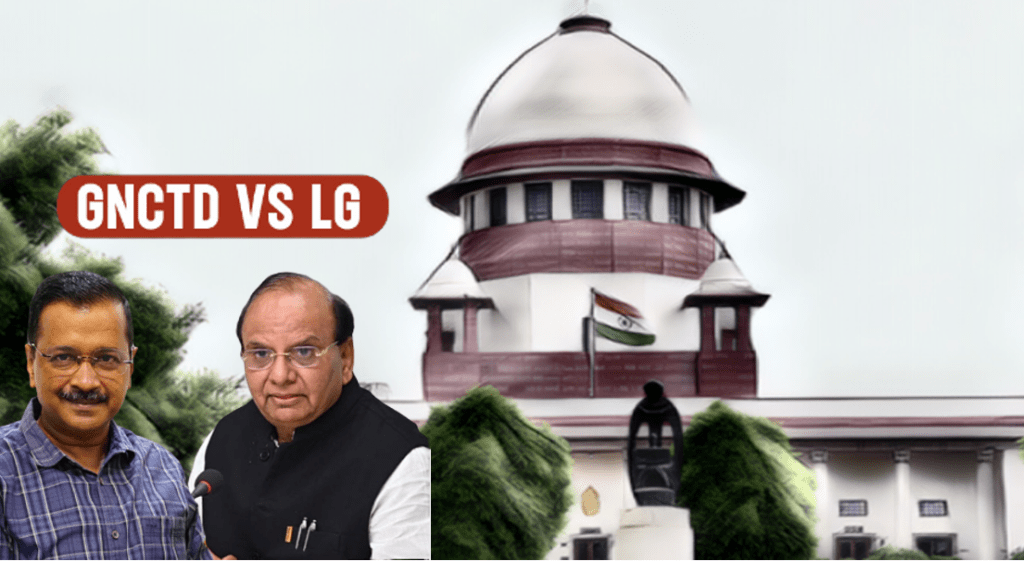
Keywords – GNCTD ordinance, Delhi, Article 239AA, Doctrine of separation of powers.
The Government of National Capital Territory of Delhi (GNCTD) Ordinance was brought by the central government to give itself the ultimate power over controlling the civil servants who are working in the National Capital of Delhi. This ordinance was brought within a week after the Supreme Court’s constitutional bench delivered a judgement upholding the power of the Delhi government over control of services except in three areas which are public order, police and land. So except in these three specified areas the Delhi government will have the power to control the transfer, postings and other matters related to the civil servants who are serving in the Delhi government. This was the Supreme Court’s constitutional bench judgement.
So now this ordinance has been brought down which has the effect of nullifying the Supreme Court’s judgement. So after the ordinance has been promulgated intense legal, political debates are going on regarding the validity of the ordinance.
I’ll be advancing arguments that this ordinance is unconstitutional for nullifying the Supreme Court’s judgement. The first basic concept that stands questioned here is that whether can the legislature by making a law over rule the judgement delivered by a court? The answer is not a straightforward yes. The legislature can indeed over rule or neutralize a judgement and it’s effect in certain circumstances. This is permissible as there are several judgements which have held that legislative over ruling is permissible by taking away the legal basis or it can be done to cure the defects which are in a law to which affect the previous judgement can be nullified. This is the basic principle.
But if a law is made by merely declaring that a judgement will have no effect, then such a law would be unconstitutional. If such laws are made then that will lead to the violation of the Doctrine of Separation of Powers and such a law can be struck down for violating Article 14 which is also equivalent to the violation of the Basic Structure of our constitution. In the recent 2021 judgement it was also sustained that when a law is made only to over rule a judgement then that law cannot be sustained and is unconstitutional.
The GNCTD Ordinance proposes to amend the Section 3 of the parent GNCTD Act and to insert a new Section 3A there, which essentially says that, “Notwithstanding anything contained in any judgement or court ruling, the Delhi government will not have powers over Entry 41 (which is related to services) subjective of the List II of the Constitution.” This section is directly contradicting the Supreme Court’s judgement, which says that Delhi government will have power over services.
So section 3A has the power of overriding the Supreme Court’s judgement. So whether this is a permissible act or not? To answer this we need to check whether this ordinance is taking away the basis of the Supreme Court’s judgement. The Supreme Court’s ruling is primarily based on the Article 239AA of the Constitution which deals with the powers of the Delhi government and also the Delhi assembly. Here Article 239AA(3)(a) says that the Delhi government or the Delhi assembly will have powers on all subjects in the List II except Entry 1, 2 & 18 which are dealing with public order, police and land. So the Supreme Court made sure that only the three entries were exempted and not the Entry 41 was exempted that is services.
This ordinance is unconstitutional as it is going way far from the Article 239AA and exempting services also on its own, which has no mention in the Constitution itself. In fact it is diluting Article 239AA. So such a provision cannot be regarded as a law even by the virtue of Article 239AA(7) which says that a law will prevail when it is supplementing the said provisions of the Article 239AA.
In 2018 it was held that in the case of Delhi, the Parliament as well the Union Territory government has the power to make laws even on the state list. So it is not the existence of the power of the Parliament which is in dispute here, the issue is that can this power be exercised to nullify a judgement. This ordinance is not taking away the basis of the judgement, what the ordinance is doing is to simply lay down that this judgement will have no effect and this is not permissible by the law settled by various precedents. This is clear cut violation of the Doctrine of separation of powers, hence unconstitutional. The second ambit is that the Supreme Court’s judgement is not only restricted to the Article 239AA but it accompanies various other constitutional principles relating to democracy and federalism. The court says that the ultimate control of administration should be resting with the elected arm of the government, because if not then what will be the need of the elected government when it has no control over the services. The government is elected by the people and it has to reflect the will of the people by making policies and it will do so with the help of the civil servants. If these civil servants only are kept isolated from the elected government then the civil servants would be unaccountable and the principle of collective responsibility will stand defeated. Hence, I would like to conclude by saying that this ordinance is a colorable piece of legislation which is violating the Supreme Court’s judgement both in its letter and spirit and is therefore unconstitutional by breaching the principle of separation of powers.
Written by – Yashashvi Mishra College – S S Khanna Girls Degree College, Prayagraj UP Semester – 2 nd year 4th semester, an intern under Legal Vidhiya



